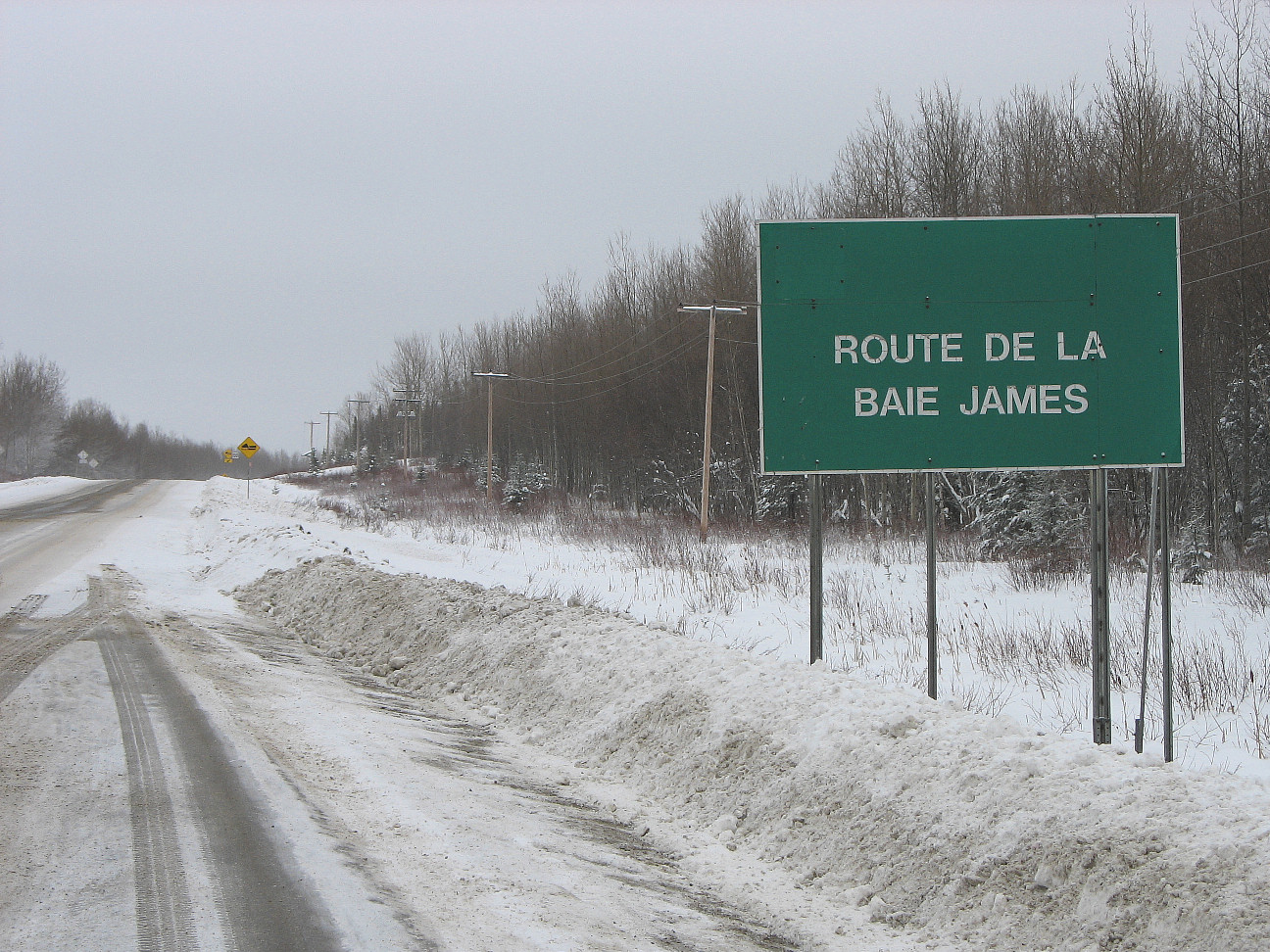
The James Bay Road — officially Route 109 in Quebec — connects the town of Matagami to the Radisson area near the Robert-Bourassa hydroelectric complex. The route covers approximately 620 kilometres through boreal forest with no permanent settlements along the corridor. It is open year-round but road surface conditions, wildlife hazards, and infrastructure availability change significantly by season.
Route overview
The road begins at Matagami, roughly 780 kilometres north of Montreal via Highway 117. From Matagami, it runs north through the boreal forest, crossing several river systems and passing through the Caniapiscau watershed area. The kilometre markers on this route are important navigation references, as the road has no intersections or named landmarks for the majority of its length. The only significant fuel and service stop along the route is the Relais Routier km 381, situated approximately midway.
Route at a glance
- Start: Matagami, Quebec (via Highway 117 from Val-d'Or)
- End: Radisson / Chisasibi junction
- Total distance: approximately 620 km
- Only mid-route service stop: Relais Routier km 381
- Road surface: paved from Matagami; gravel sections beyond km 274
- Fuel availability: Matagami, km 381 service centre, Radisson
Fuel stop spacing
The gap between the km 381 service centre and both Matagami and Radisson is approximately 240–380 kilometres depending on direction. For most standard passenger vehicles, a full tank departing either endpoint should be sufficient to reach the midpoint. However, fuel consumption increases in winter due to engine idling, longer warm-up periods, and increased rolling resistance in cold or snowy conditions. Carrying a supplemental fuel container (where legal and safe) is advisable for winter travel.
The km 381 service centre offers fuel, basic food, a telephone, and emergency services. It is staffed and offers overnight accommodation, though it is not a full-service hotel. Travellers should not assume the service centre will have everything they need — carrying spare parts, food, and water is standard practice for this route.

Seasonal conditions by period
Winter (December–March)
The road is typically passable in winter, but conditions vary significantly with temperature and snowfall. At temperatures below approximately –20°C, road surfaces compact and provide reasonable traction; at temperatures near 0°C, surfaces become variable and icing is common. The road is used for heavy freight in winter, which means encountering large trucks is routine. Night temperatures regularly fall below –30°C in northern Quebec, which affects vehicle starting, fuel viscosity, and tire pressure.
The Ministère des Transports du Québec maintains a road condition reporting service relevant to this route. Conditions are posted for Route 109 during active weather events.
Spring (April–May)
Spring is the most challenging period on the James Bay Road. The combination of frozen ground thawing from above while remaining frozen below creates conditions where road bases become saturated and soft. Frost heaves — sections where the road surface has buckled upward due to ice formation beneath it — are common in April and May. These can range from minor bumps to significant obstacles capable of damaging vehicle suspension and tires at speed. Driving speeds well below the posted limit are necessary during this period.

Summer (June–September)
Summer provides the most predictable conditions on the paved sections. The gravel portion beyond km 274 generates significant dust in dry conditions; following another vehicle too closely results in severely reduced visibility. Insects — particularly blackflies and mosquitoes — are present in high numbers from June through August. This is not a safety hazard for vehicle travel but is relevant for any time spent outside the vehicle.
Autumn (October–November)
Early autumn is generally stable before freeze-up. Ice formation on the road can begin in October at higher latitudes on this route. Late November often brings mixed conditions — partially frozen ground, ice, and wet snow — that require winter-rated tires. Quebec law requires winter tires from December 1 to March 15, but conditions on this route may warrant earlier installation.
Wildlife
The James Bay Road corridor passes through active boreal wildlife habitat. Moose crossings are frequent and are among the most significant collision hazards on this route. Moose are large enough to be fatal in a collision with a passenger vehicle and are difficult to see at dusk, dawn, or night due to their dark colouring. Travelling at reduced speeds during low-light conditions and scanning road margins continuously are appropriate precautions. Bears, wolves, and woodland caribou are also present in the corridor, though vehicle collisions with smaller animals present less structural risk.
Emergency services and communication
Emergency response times on the James Bay Road are long by southern standards. The distance from either end of the route, combined with limited cellular coverage along most of the corridor, means that self-sufficiency is essential. Cell coverage exists in Matagami and in Radisson but is absent for most of the intervening distance.
A satellite communicator capable of two-way messaging and GPS tracking is strongly advisable. Devices such as the Garmin inReach allow distress alerts to be sent with GPS coordinates from any point along the route, which significantly reduces the time between an incident and a response.
Vehicle requirements
The paved sections of the route are accessible to standard passenger vehicles. The gravel sections are also passable in standard vehicles but are harder on tires and suspension, particularly during spring and post-storm periods. Ground clearance above approximately 15 cm is advisable for the gravel portion, and carrying two spare tires is recommended due to the long distances between service facilities. All-season tires are marginal in winter; winter-rated tires are appropriate from October through April.
| Item | Notes |
|---|---|
| Spare tires (×2) | Distance between tire service is 240–380 km |
| Supplemental fuel container | Particularly relevant in winter |
| Winter tires | Required in Quebec Dec 1–Mar 15; useful Oct–Apr |
| Jumper cables or booster pack | Cold starts can drain batteries quickly |
| Tow rope or recovery strap | For getting unstuck from soft or icy road edges |
| Satellite communicator | No cell service for most of the route |
| Food and water (2–3 days) | In case of breakdown or extended delay |
| Sleeping bag rated to –20°C or lower | For unexpected overnight stay in vehicle in winter |

